
Archive for the ‘general math’ Category
Like many math bloggers, I was starting to worry that the Carnival of Maths had died a death after John hosted the excellent 50th edition. However, that’s not the case, it was just resting. The carnival is alive and well and it looks like it will be hosted over at Squarecirclez tomorrow. If you are a blogger and have recently written something mathematical then head over to the Carnival submission form and submit it.
You know you want to!
Imagine that you were the Captain of a sailing ship a few hundred years ago and, in order to protect yourself from pirates, you had a few cannons. Cannons need cannonballs and it is well known that the best way to stack cannon balls is to arrange them as a square pyamid as in the image below.
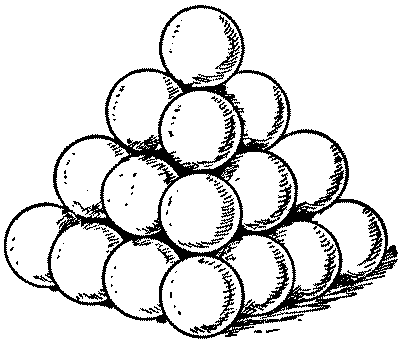
So, in this example you have 16 balls in the bottom layer, 9 balls in the next layer, then 4 and, finally, one at the top giving a total of 16+9+4+1 = 30 balls and we say that 30 is the 4th square pyramidal number. The first few such numbers are
- 1
- 5 (4+1)
- 14 (9+4+1)
- 30 (16+9+4+1)
- 55 (25+16+9+4+1)
Now, there is a well known problem called the Cannonball problem (Spolier alert: This link contains the solution) which asks ‘What is the smallest square number that is also square pyramidal number?’ but the traditional cannonball problem has been stated and solved by many people and so it isn’t my problem of the week.
My problem is as follows ‘Consider a square pyramidal pile of identical cannonballs of radius r such that the bottom layer contains 16 cannonballs (such as the pile in the diagram above). Find the volume (in terms of r) of the pyramid that envelops and contains the whole pile‘
As always, there are no prizes I’m afraid (but if you are a company who would like to sponsor prizes for future POTWs then let me know). I imagine that the solution to this will require a diagram so it might be best to put your solution on a pdf file, web page or some other visual media rather than using the comments section. Finding my email adress is yet another (easy) puzzle to solve.
Have fun.
Over at Wild about Math, Sol introduced pandigital fraction sums of the form

I call these sums pandigital because the left hand side contains every digit from 0-9 once and once only. Sol challenged his readers to come up with more equations of this type and so I had a crack using Mathematica.
In order to keep the number of solutions down (and to keep them as close as possible to Sol’s original examples), I only considered sums with four terms – 2 of which were integers and 2 of which were fractions. In other words sums of the form

My next simplification was to only consider numerators and denominators of up to 2 digits each so fractions such as 123/456 were immediately out. As you might expect, I also didn’t count trivial re-arrangements of the terms as separate solutions.
Finally, I didn’t insist that the fractions were written in their lowest terms so, for example, 38/76 is allowed even though it could be rewritten as 1/2. Since one of Sol’s original examples contained such a fraction, I didn’t want to remove them. This also meant that I allowed fractions that could be rewritten as integers such as 48/16.
Even with all of these restrictions in place I came up with 580 solutions! One of which is

Interestingly, (unless I have made a mistake) it seems that if you insist on having fractions in their lowest terms then there are no solutions at all!
Does anyone out there have anything to add to this little problem? Have I messed up and missed a solution or is one of my solutions incorrect? Have I missed something obvious? Are there more interesting variations? Anything?
From time to time I post a problem of the week on Walking Randomly and invite readers to post solutions. Although I haven’t done many, they seem to be quite popular and so I plan on resurrecting the series soon.
Back in August last year I posted a problem concerning Fibonacci numbers and matrices and Sam Shah (Of Continuous Everywhere but Differentiable Nowhere fame) took the time to write out a full solution in a PDF file and sent it to me via email. I promised that I would publish it ‘soon’.
Well…umm…’soon’ turned out to be almost a year later. Here is Sam’s solution to the original problem – enjoy!
Sorry Sam!
The latest edition of the blog carnival, Math teachers at play, has been published over at Homeschool Bytes. There’s lots of great stuff to be found there from chessboard counting problems through to trachtenberg math. Head on over and check it out.
Does anyone know what has happened with its sister carnival – the Carnival of maths? I’ve not heard a thing about it since the last edition over a month ago.
My brother sent me a link to the song below and I am loving it. You’ll need a smattering of undergraduate mathematics to get the jokes but if they sail cleanly over your head then start googling the terms. I’ve never seen a better motivation to learn group theory ;)
This is old,old news so I apologise to anyone who may have seen it before.
Update: Wow! These guys have produced a CD with this song on it. Ordering now….(no I won’t get any comission if you do the same).
Over at The Endevour, John Cook considers the martial arts movie Redbelt which differentiates between martial arts competitions and real fights. Competitions tend to have artifically imposed restrictions (aka ‘the rules’) whereas real fights don’t. In his post, John likens this to the difference between real world maths problems and academic maths problems.
Taking the martial arts analogy one step further – I was reminded of a quote from Bruce Lee while reading John’s post.
‘Before I studied the art, a punch to me was just like a punch, a kick just like a kick. After I learned the art, a punch was no longer a punch, a kick no longer a kick. Now that I’ve understood the art, a punch is just like a punch, a kick just like a kick.’
I used to practise Taekwondo back in the day and I can relate to what Bruce was saying. When you start Taekwondo you expect to be taught how to kick, and you are, you are taught how to do a ‘side kick’ and a ‘front snap kick’ and a ‘turning kick’ and an ‘axe kick’ and a…..well you get the idea. A kick for every occasion.
All these kicks to learn with each one having its own set of detailed technical nuances. I spent years developing the perfect ‘spinning reverse turning kick’ for example and got seriously good at it – everyone was impressed with my kick. It was a beautiful, powerful, amazing kick and I was proud of it.
However, I rarely managed to hit anyone with it in a competition scenario. Of course if I ever did score a point with it then the crowd would go crazy – it looked great and they loved it. It just didn’t happen very often. Futhermore, in a real fight I would be a moron to even think about using it. It was too inefficent, too slow and put me at too much risk. It involved briefly having my back to my opponent while doing the spin for pity’s sake.
Over the years of learning these fancy techniques I somehow missed the point…which was to learn how to plant your foot on your opponent as fast and powerfully as possible with the minimum of fuss. All the tehncial paraphernalia was just a means to an end but I got caught up trying to develop the ‘perfect kick’ for its own sake. The application didn’t concern me.
I never got very good at winning fights but I had a whole load of fun and that’s what I really did Taekwondo for.
Back to mathematics….
When solving a mathematical problem how do you go about it? Do you insist on always using certain favourite techniques to get the job done? Will you only accept and publish the answer if you reached it by some clever, beautiful and impressive means? In short are you perfecting the perfect spinning reverse turning kick which will only work occasionally but when it does everyone oohs and aaahs at your technical prowess.
On the other hand will you use any dirty, sloppy and downright underhanded method in your arsenal to solve the thing? Who cares how you get the answer as long as you get it? Street Fighting Mathematics maybe?
Personally, with both Mathematics and Martial arts, I don’t think that there is a ‘right way to do it’ just as long as you are aware of what you are doing.
Some time ago now I wrote about an integral that Mathcad 14 had trouble with and also asked if anyone could solve it by hand.

Well, James Graham-Eagle of the University of Massachusetts has risen to the challenge and provided me with the full solution as a pdf file which I offer to you all for your downloading pleasure. Thanks James!
The second edition of the new blog carnival ‘Math teachers at play’ has been posted over at ‘Let’s play math’. Although I am not a maths teacher, I do like to play with math and there is certainly a lot to play with in this carnival. Why not head over there to see what is on offer?
If you are the owner of a maths based blog and would like one or more of your posts included in the next edition of this carnival – (which will be over at f(t) on March 20th) – then simply submit something via the submission form. Carnivals such as these are a great way to get involved with the wider blogging community and are also a good source of inspiration.
Enjoy!
I have an Amazon gift voucher burning a hole in my (virtual) pockets and I thought I would treat myself to a maths book. The problem is that I have around 200 potential candidates on my wish list – truly an embarrassment of choice. So much choice that I am stupefied by it – I have no idea what I should order.
So dear reader, help me out please. What would you suggest I get?