
Archive for the ‘general math’ Category
The 41st Carnival of Maths is now available over at 360 and includes two articles from Walking Randomly. Don’t let that put you off though as there is loads of other great stuff for your reading pleasure.
While reading 360’s recent post about crop circles, I was reminded of something similar that caught my attention a while back – this:

What you are looking at is the phrase “Hello, world!” encoded in Semacode and mown into a wheat field. Measuring 160m x 160m, it is possibly the largest “Hello, World!” program every written. It was made back in 2007 by German programmer bernhard hopfengärtner who aimed (and succeeded) to get it included in aerial photography taken by Google Earth.
The Challenge
Now I have no idea if this is possible but that does not stop me asking the question. Can anyone come up with a program that takes the above image as input, parse the semacode and see if it really does print “Hello World.”
I guess something like MATLAB would have some of the required functionality in its image toolbox but I haven’t yet googled to see if there is a suitable open source Semacode algorithm that you could feed the image into.
Have fun!
Just as I was about to give up on the Carnival of Mathematics, up pops the long awaited 40th Edition over at Staring at Empty Pages. Lots of juicy mathematical tidbits have been included for your enjoyment including some interesting stuff on the factorial function, generating functions, Euclid’s Elements and a whole lot more.
I am a huge fan of the carnival of Maths and have hosted it twice myself so far. In my opinion, it’s a great way of discovering new maths-related blogs and new mathematical ideas. The carnival also helps foster a sense of community among us all. One thing that it desperately needs though is new hosts so please contact Alon and volunteer for the job.
The 41st carnival will be hosted by the guys over at 360. Do your blog a favour and submit your latest maths-related post to the carnival.
I recently discovered a wonderful mathematical podcast called The Math Factor from the University of Arkansas and in their current episode they pose the following question.
“What is the smallest positive counting number that Google can’t find”
Let’s try a few searches to see what we can find:
- ’10’ gives 15,360,000,000 hits so that is definitely not what we are looking for!
- ‘35672’ gives 809,000 hits – better but still nowhere near
- ‘567906’ gives 6,400 hits – getting closer!
As you might expect it is easy to come up with any old example of an integer that google doesn’t know about but the smallest will be somewhat harder to find. For example as I write this there are no hits for ‘56790636782356487252’ but that is rather large (and, thanks to this page, will probably result in a google hit soon)!
Can you do any better? If so please do not leave a comment here telling me what it is and please do not blog about it on your own site because, as soon as you do, it will lose the very property that makes it interesting. Instead, please send a message to the guys at Math Factor by using this link and tell them Walking Randomly sent you!
Update (8th September 2008): Michael Lugo has more to say on this question over at God Plays Dice.
“Do you like pendulums?” I was asked, “because if you don’t like pendulums then I wouldn’t bother with A-Level physics if I were you.” This was the advice given to me by an outgoing sixth-former at a school open day around 14 years ago. He had obviously had an unhappy time during his physics studies and was doing his best to turn me away from the subject but he hadn’t counted on the fact that I actually do like pendulums. Besides, I figured that high-school physics isn’t only about pendulums – they’ve got springs too!
Of course everyone knows what a pendulum is – thing that swings back and forth, used in grandfather clocks. When all is said and done, you might argue that pendulums are simple, sometimes useful and, above all, dull. My sixth-form friend certainly thought so but maybe that was because he didn’t have enough pendulums!
One pendulum is useful but two are much more interesting and four can be downright fun! The Victorians certainly thought so and over 100 years ago they used to build home entertainment devices out of pendulums called harmonographs. You have probably never heard of a harmonograph (I certainly hadn’t until a couple of days ago) and so maybe a bit of detailed explanation is in order.
Imagine that you have attached a pencil to a pendulum so that it brushes across a piece of paper as the pendulum swings back and forth. When the pendulum finishes swinging you will end up with a single straight line drawn on your paper – very dull indeed! Now imagine further that you somehow manage to connect a second pendulum to your pencil which oscillates at right angles to the first. The resulting drawing might look something like the image below. If your imagination fails you (or if my explanation isn’t up to the job) then you can see a video of the set up I am trying to describe by clicking here.
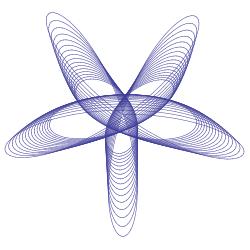
Alternatively, you could have one pendulum attached to the pencil and another attached to the drawing surface as in the example below.
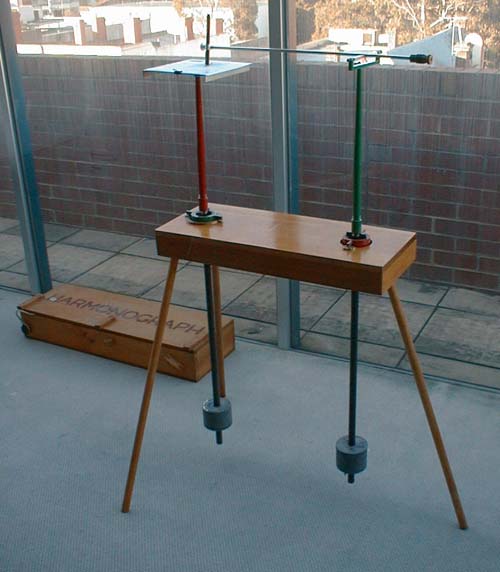
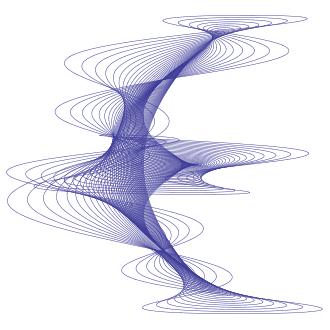
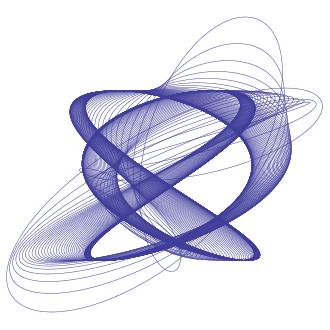
There are many different designs for harmonographs and some manage to incorporate up to 4 different independent oscillations by attaching pendulums to the drawing surface as well as the pencil itself. The resulting drawings can be spectacular.
So how might we go about simulating a harmonograph? Well the motion of a single damped pendulum along the x axis can be described by the parametric equation

where t denotes time, p is a phase factor between 0 and 2*pi and d is the strength of the damping term. The larger you make d, the more quickly the pendulum oscillations will decay.
If we have two independent pendulums oscillating along the x-axis, both contributing to the overall motion of our pencil then, thanks to the principle of superposition, the total motion along the x-axis is given by

If we also have two pendulums oscillating along the y-axis then the final set of equations is

Now, if you search the internet you will find that other people have written down equations for harmonograph plots and you might find that they look slightly different to the ones I have written above but you should always be available to transform my equations into any other valid set. For example, the equations given in the website here describe a system with only three pendulums so simply cross out the second term for y(t) in my set of equations and you are almost done. You might also find that some people use Cosine instead of Sine – in which case you simply set the phase in my equations to be pi/2 since sin(x+pi/2) = cos(x).
Something else I have done is to assume that the initial amplitude of all of my pendulums is set to one. This is because I already have 12 parameters to play with which I think is more than enough for an initial play around.
As an aside, it turns out that these equations can describe much more than just Harmonographs. For example, by setting the damping factors to 0 and by crossing out the second term in each equation (thus only considering 2 oscillators) you will end up with Lissajous figures. With a bit of algebraic manipulation you can also obtain the equations that describe spirograph curves – see this link for the details.
So, we have a set of parametric equations and we want to plot the result. In Mathematica the ParametricPlot command is what we need so let’s give our 12 parameters some numbers and see what we can come up with.
ParametricPlot[{Sin[2 t + Pi/16] Exp[- 0.02 t] + Sin[6 t + 3 Pi/2] Exp[-0.0315 t], Sin[1.002 t + 13 Pi/16] Exp[-0.02 t] + Sin[3 t + Pi] Exp[-0.02 t]}, {t, 0, 167}, PlotRange -> All, Axes -> None]

This is all very nice but it would be much nicer if we could manipulate the parameters with a set of sliders rather than having to manually type them in each time. My first attempt at producing such a graphical user interface to the above function in Mathematica looked like this (click the image to download an interactive notebook version that can be used in the free Mathematica Player application from Wolfram)
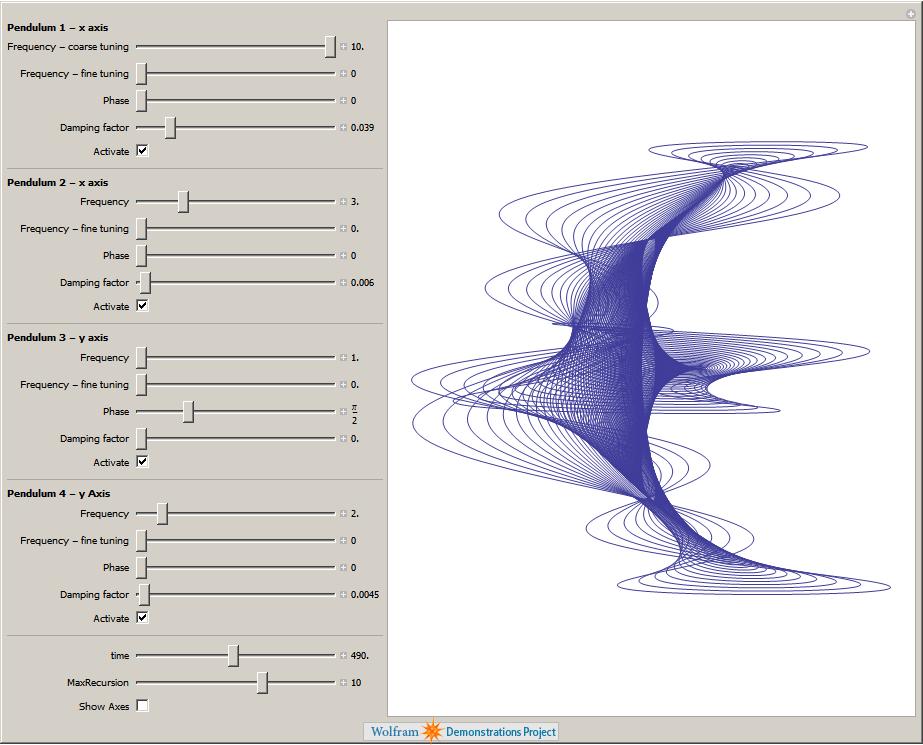
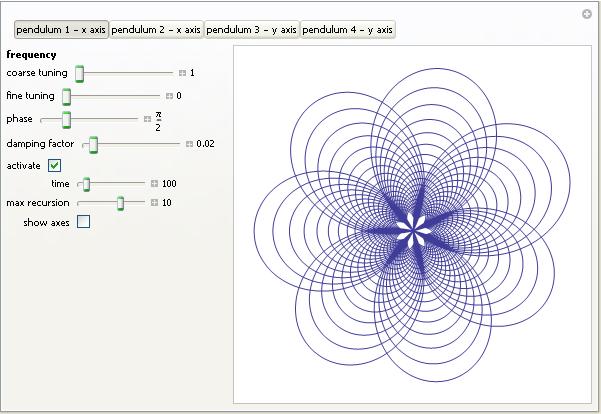
I quite like this version as you can see all of the parameters at once but it turned out to be too big for inclusion in the Wolfram Demonstrations Project. I tried various tricks to try and shoe-horn all of those parameters into a smaller applet and was about to give up when an employee at Wolfram sent me some code that sorted out the size problem by introducing a set of tabs. I like his solution so much that I’ll probably be writing about it soon in a separate article. The resulting Wolfram Demonstration was published today – click on the image below if you’d like to take a look.
Things that I haven’t done yet but might in the future include
- Animate the plot so that it looks more like the real thing.
- Add colour.
- Add the ability to modify the starting amplitude of each pendulum.
Of course the source code is available so if you have a burning desire to do any of these yourself then feel free – but please let me know if you do. I hope that you enjoy the results of these applets and would love to see any particularly interesting images that you might come up with – sending the equation parameters would be useful as well.
Parameters for reproducing the images above
Hover your mouse over a plot to see what image number it is
- Image 1: f1=3.001 f2=2 f3=3 f4=2 d1=0.004 d2=0.0065 d3=0.008 d4=0.019 p1=0 p2=0 p3=pi/2 p4=3pi/2
- Image 2: f1=10 f2=3 f3=1 f4=2 d1=0.039 d2=0.006 d3=0 d4=0.0045 p1=0 p2=0 p3=pi/2 p4=0
- Image 3: f1=2.01 f2=3 f3=3 f4=2 d1=0.0085 d2=0 d3=0.065 d4=0 p1=0 p2=7 pi/16 p3=0 p4=0
- Image 4: f1=2 f2=6 f3=1.002 f4=3 d1=0.02 d2=0.0315 d3=0.02 d4=0.02 p1=pi/16 p2=3pi/2 p3=13 pi/16 p4=pi
Harmonograph Resources
Hopefully, this article has whetted your appetite for harmonographs – if so then you might find the following resources interesting.
- How to Make a Three-Pendulum Rotary Harmonograph by Karl Sims
- Instructions for building your own harmonograph from chestofbooks.com
- More instructions for making harmonographs from 1920-30.com.
- Analysis of a home built harmonograph – a great model, I’m not sure about his equations though.
- Harmonograph – A visual guide to the Mathematics of Music
. A book by Anthony Ashton.
- The Meccano Super Models (Volume 2) by Geoff Wright. ISBN 0-904568-07-5 contains instructions for making a Harmonograph out of Meccano. I can’t get hold of a copy unfortunately.
- The following two journal articles contains some interesting historical and technical information concerning harmonographs.
- American Journal of Physics — February 2001 — Volume 69, Issue 2, pp. 162-173
- American Journal of Physics — February 2001 — Volume 69, Issue 2, pp. 174-183
- Harmonograph simulator written in tcl.
- Java Harmonograph simulator.
If you enjoyed this article, feel free to click here to subscribe to my RSS Feed.
The 39th Carnival of Mathematics has been posted over at It’s the Thought that Counts and the wide variety of articles on offer there is as good as ever. Topics include pole vaulting, knots, the statistics of Olympic performance and the Joy of Hex along with a while lot more! I defy you to find something you are not interested in.
The 37th Carnival of Mathematics was posted over at Logicnest last week with 13 (if I have counted correctly) articles for your reading pleasure. There is some really good stuff to be found in this edition of the carnival but I won’t spoil the show by telling you all about it here.
The next Carnival will be hosted by catsynth, although the carnival submission form doesn’t seem to know that yet. If you are a blogger and have recently written a maths based post then please think about sending in a submission.
No integral this time – I’m saving those for another day. This week’s problem is
Give a proof of the relationship between the Fibonacci Numbers and the determinant of the matrices discussed in this post.
As always, this is just for fun as there are no prizes (unless, of course, some kind sponsor would like to help me out).
Feel free to give submissions via the comments section but, be warned, it doesn’t support latex. Probably the best way to submit your solutions would be to send them to my email address. I’ll take just about any format – even Microsoft word – but pdf or Latex is probably best. Solutions that I think to be correct will be published here at a later date (subject to obtaining your permission of course).
Have fun.
Update: Click here for the solution.
If you enjoyed this article, feel free to click here to subscribe to my RSS Feed.
Many years ago (way WAY before the web), at the tender age of 10, I did a school math project about the Fibonacci numbers and got rather carried away with writing about the many different areas of mathematics and everyday life where this sequence popped up. Although I didn’t have the internet to help with my research, I did have a wonderful maths teacher called Ron Billington who taught for many years at Birchensale Middle School in Redditch. Mr Billington had a personal library of maths books that he collected over the years which was a treasure trove of material for someone like me who had significantly more enthusiasm than talent. He would have loved hearing about the little discovery I made while browsing through The College Mathematics Journal the other day.
First, a bit of background. The Fibonacci sequence starts off like this:
1 1 2 3 5 8 13 21
Each term in the sequence is formed from the sum of it’s two predecessors so the next term would be 13 + 21 = 34. What fascinated me as a child (and continues to fascinate me now) is the fact that this incredibly simple sequence of numbers, and others like it, seems to appear all over the place from the distribution of sunflower seeds to the study of photonic crystals.
There really is an astonishing amount of mathematics around the Fibonacci sequence as you will be able to verify with a quick google search. There is even an academic journal dedicated to the mathematics around it – The Fibonacci Quarterly – which I, unfortunately, have no access to at the moment (might have to have a word with the University librarian about that).
In the article Fibonacci Determinants, by Nathan Cahill et al (The College Mathematics Journal vol33 p221-225), the authors demonstrate the fact that you can obtain the nth term in the Fibonacci sequence by taking the determinant of a n x n tridiagonal matrix of the form
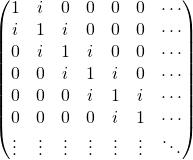
What’s more, if you change just a single entry (row 2 col 2) from 1 to 2 then you will obtain the Lucas Numbers instead. I thought that this was fun and so knocked up a Wolfram Demonstration for it which you can get to by clicking on the image below.

So Mr Billington – I have found yet another branch of Mathematics where the Fibonacci numbers turn up – Linear Algebra. I know it’s been 20 years but is there any chance of upping that B- to an A :) ?
If you enjoyed this article, feel free to click here to subscribe to my RSS Feed.
The second Integral Of The Week (IOTW) is rather different from the first in that I am going to give you the evaluation. Your task is to prove it.

But WAIT! Almost every time I have seen this integral evaluated, it has been done by squaring it and converting to polar co-ordinates and that’s the one method of evaluation you can’t use for this particular challenge. I am looking for more ‘interesting’ proofs. Have fun.
Solutions can be posted in the comments section or sent to me by email (obtaining my email address is another puzzle for you to solve) and will be discussed in a future post. Feel free to send your solution in just about any format you like – plain text, uncompiled Latex, PDF, postscript, Mathematica, ODF, even Microsoft Word. When I get around to posting the solutions I will attempt to standardize them (to PDF probably).
Update: Several solutions have been posted in the comments.